Menu

Risk Management Platform · RMP

Enterprise Project Risk & Opportunity Management Platform

Manage project risks from bid preparation through delivery

Deliveries can be delayed, engineering designs evolve, and contract costs rise. Teams must anticipate consequences early and revisit assessments as projects change. RMP brings this entire workflow into a unified workspace.

Project overview
Project overview

Understanding the process

What project teams define as risk

A risk is an uncertain event or condition that can impact project objectives: schedule, cost, safety, or engineering performance. An opportunity represents an uncertain event with positive impact. Before an event occurs, the team can assess it and implement preventive actions.

Core elements of risk management

The register records root cause, potential event, and consequence. The assessment establishes likelihood and impact: against standardized rating scales, and for contingency reserve calculation in currency and days. A mitigation action defines what will be done, by whom, and by when. Periodic reviews capture changes, contingency reserves account for budgetary uncertainty, and risk appetite establishes when matters escalate to higher leadership.

Register

Root Cause

Potential Event

Consequence

Assessment

likelihood × impact

Mitigation Action

What · Who · Due Date

in progress

Review & Monitoring

Audit & change history

Reserve & Risk Appetite

threshold

Two project phases, distinct decisions

The projects we serve

New industrial facilities, plant expansions, revamps, and large infrastructure programs. Each operates under rigid budgets, master schedules, complex teams, and contractual client commitments. Together, multiple projects form a portfolio where executive leadership allocates attention and capital.

Phase 1 · Pre-Contract 1

Proposal & Tender Phase

During the commercial phase, the team evaluates uncertainty in pricing, milestones, and technical specifications. Some risks belong strictly to the tender bid, while others carry over into execution alongside contractual assumptions.

Phase 2 · Post-Contract 2

Project Execution Phase

Following contract award, the team monitors deliveries, work packages, and engineering changes. Carrying over and new risks receive assigned owners, planned mitigation measures, periodic reviews, and recorded actual impacts upon event occurrence.

Who takes decisions

Engineers, procurement leads, and discipline heads identify emerging events. The risk owner is accountable for record accuracy and action execution. The risk manager upholds corporate methodology and prepares cross-project analysis. Project directors and corporate executives decide priorities within delegated authority.

A risk scenario in practice

A supplier might delay critical equipment delivery. The team determines when this delay becomes critical for site installation, quantifies potential cost impact, and evaluates whether rescheduling work packages mitigates the disruption. If the delay actually materializes, actual outcomes are benchmarked against prior estimates to assess the effectiveness of mitigation actions.

  1. 01

    Engineers, procurement & discipline leads

    Identify potential risk events early

  2. 02

    Risk owner

    Accountable for assessment and mitigation plan

  3. 03

    Risk manager

    Applies shared methodology, builds the complete picture

  4. 04

    Project manager & executive leadership

    Make decisions within delegated authority limits

Issues escalate to the level where they can be resolved

What changes for the team

01

Unified Picture

Consolidate risk and opportunity data across all projects in a single workspace. Navigate easily from portfolio summaries down to individual risks, owners, and planned actions.

02

Comparable Assessments

Apply standardized assessment rules across all projects while maintaining clear traceability to the applicable methodology version.

03

Actionable Mitigations

Link every material risk to an executive decision, structured mitigation plan, target deadlines, approved budgets, and accountable owners.

04

Substantiated Reserves

Quantify potential cost and schedule exposure using probabilistic analysis and Monte Carlo simulations to justify contingency and management reserves.

05

Defensible Reporting

Show not just the current risk state, but reasons for changes, decision history, and register snapshots for any selected date.

06

Lessons Learned

Leverage historical outcomes from completed projects and AI assistants to continuously improve the accuracy of future assessments and committee materials.

01 Portfolio Risk Overview

Understand risk concentrations and pinpoint projects requiring intervention

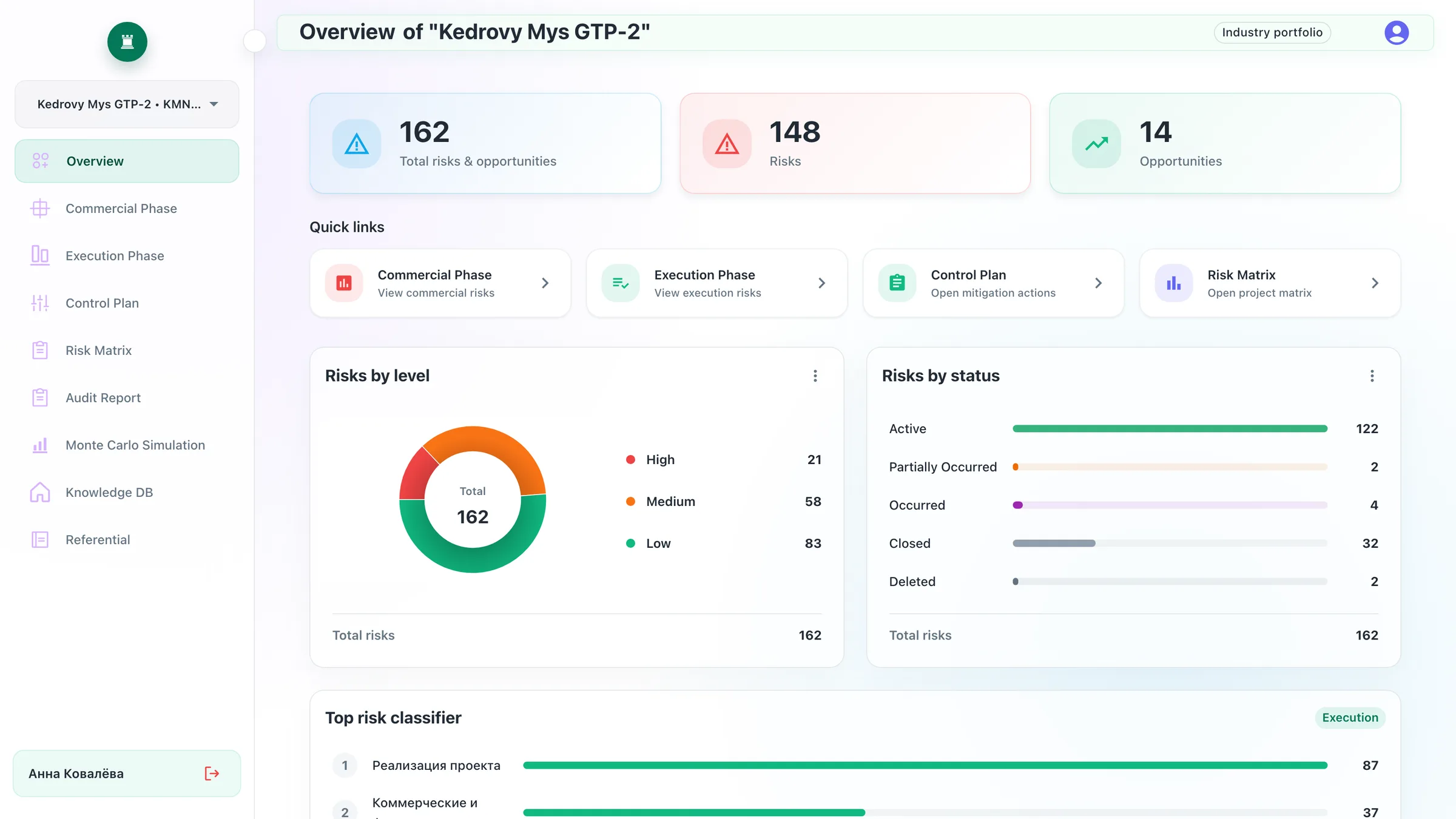
In an enterprise portfolio, one project is preparing a tender proposal, another is procuring long-lead equipment, while a third is entering site installation. Executives need a consolidated high-level overview, yet decisions always impact specific assets. RMP visualizes risks across project phases, severity levels, and statuses. From executive metrics, users can drill directly into the underlying risk record, assigned owner, and planned mitigations.

The project charter maintains contractual milestones, baseline costs, contingency reserves, project teams, and work breakdown structures. Risk managers spot data quality issues early, while leadership identifies top priorities for executive review.

What you can do

  • Browse assigned portfolio projects with role-based access
  • Benchmark projects across delivery phases, risk profiles, and statuses
  • Analyze current and target risk exposure
  • Drill down from portfolio KPIs to source registers and actions
  • Configure work breakdown structures and custom project attributes
  • Track project budget, revenue, and reserves in primary and project currencies
  • Connect risks to project milestones and model their time windows of occurrence
  • Formally baseline and approve project assessment assumptions with designated owners

02 Enterprise Methodology

Configure RMP to your company's risk methodology

A 30-day delay has drastically different implications for a short shutdown maintenance project compared to a multi-year industrial megaproject. Organizations define custom likelihood and impact scales, risk scoring formulas, dimensions (cost, schedule, safety, reputation), and escalation thresholds. During assessment, team members reference unambiguous definitions for each scale score, giving leadership total confidence in how ratings were derived.

When methodology evolves, newly published versions are versioned alongside historical assessments. This preserves comparability across multi-year programs and defends past investment decisions. Risks exceeding tolerance thresholds trigger automated escalation routes and governance reviews.

What you can do

  • Standardized, comparable assessment methodology across all portfolio projects
  • Configurable likelihood and impact scales, dimensions, formulas, and matrices
  • Full version control for methodologies and audit traceability of assessment baselines
  • Explicit risk appetite and tolerance thresholds across operational dimensions
  • Approval matrices and automated escalation paths based on risk severity
  • Flexibility to evolve risk methodology alongside organizational maturity

03 Risk Lifecycle & Registers

Maintain full risk context from initial identification to realized outcome

A risk often emerges during tender preparation. When the contract is awarded, the record transitions into execution alongside its baseline assessment, assumptions, and history. The delivery team understands the initial pricing assumptions and sees how risk profiles evolve during field execution.

The risk card unifies root cause, potential event, consequences, risk owner, and the time horizon of potential occurrence. Teams iterate qualitative and quantitative ratings, log event realization, or close risks with formal sign-off. Opportunities follow an identical structured workflow to systematically capture schedule acceleration and cost savings.

What you can do

  • Manage risks, opportunities, positive claims, and change orders
  • Distinguish between commercial bidding and contract execution phases
  • Track lifecycle statuses: Active, Occurred, Partially Occurred, and Closed
  • Establish parent-child hierarchies and linked risk dependencies
  • Perform structured qualitative and quantitative risk assessments
  • Capture current and target risk ratings before and after actions
  • Correlate qualitative severity levels with monetary and schedule ranges
  • Categorize risk drivers, financial impacts, and schedule delays in calendar days
  • Two-way register import and export via Microsoft Excel
  • Prepare risk data packages for Primavera Risk Analysis
  • Generate single-page risk cards in PDF for executive briefings

04 Actionable Mitigations

Transform identified uncertainties into controlled, accountable actions

Once a project team understands potential impacts, it must formulate a response. For each significant risk, teams build an action plan detailing what will be done, who is accountable, estimated cost, and completion target. Complex mitigations can be broken into sequential milestones with contingent fallbacks ready if primary measures fail.

Milestone dates and action costs are displayed next to the risk rating. When deadlines change, the reason is recorded. Project managers approve action plans or formally accept risks within delegated limits; issues exceeding these limits escalate higher. Later, teams can compare mitigation costs with the observed reduction in risk severity.

What you can do

  • Select response strategies: Mitigate, Avoid, Transfer, Accept, or Exploit
  • Design multi-step action plans, fallback measures, and contingent strategies
  • Assign clear action owners and monitor milestone deadlines
  • Benchmark mitigation budgets against expected monetary value reduction
  • Evaluate mitigation ROI based on observed decrease in risk exposure
  • Formalize action approval workflows and risk acceptance sign-offs
  • Track and govern decisions exceeding organizational risk appetite
  • Automated escalation triggers aligned with corporate delegation of authority

05 Monte Carlo & Reserves

Substantiate contingency reserves using probabilistic Monte Carlo modeling

Project teams define probabilities of occurrence alongside minimum, most likely, and maximum ranges for cost and schedule impacts. Monte Carlo simulation synthesizes thousands of iterations into clear probability distributions. Percentiles from P50 to P95 help teams discuss what reserve amount covers a selected share of model outcomes.

Pre- and post-mitigation modeling curves demonstrate the tangible financial impact of proposed risk treatments. S-curves and tornado sensitivity charts spotlight the dominant drivers of uncertainty across the project budget. Simulation parameters and input data are saved, allowing teams to re-run calculations and explain reserve changes.

What you can do

  • Calculate expected monetary value (EMV) for individual risks and full registers
  • Benchmark probabilistic outcomes before and after planned mitigations
  • Select coverage levels from P50 to P95 based on risk appetite
  • Analyze outcome probability densities, cumulative S-curves, and percentiles
  • Identify top variance contributors via tornado sensitivity charts
  • Account for common risk factors, correlation coefficients, and dependencies
  • Save and revisit reproducible simulation runs
  • Govern drawdown and replenishment of contingency and management reserves
  • Expand probabilistic analysis toward NPV and EBITDA capital expenditure stress tests

06 Reviews & Change Monitoring

Track dynamic changes, review cadence, and governance health

An assessment made at project kickoff gradually becomes outdated. RMP tracks review schedules, owners, and decision history, flagging overdue reviews and missing information so teams revisit risks on time.

When an event occurs, teams record actual costs, delays, and notes to compare against previous estimates. Exposure trends explain whether changes come from new, closed, or re-evaluated risks. Indicators and review campaigns help track changes across multiple projects.

07 Executive Reporting & Audit

Convert live risk registers into decision-ready executive materials

In meetings, leadership needs to see what changed since the last review and what decisions are needed now. RMP compiles risk heat maps, exposure trends, and change rationales directly from the project team's live register.

For reviews and audits, teams can open register states as of any past date alongside detailed field change history. Locked reporting releases freeze data, methodology versions, and sign-offs for the board, risk committee, or client.

What you can do

  • Dynamic risk heat maps with direct drill-down into source records
  • Comparative analysis of current and target portfolio exposure
  • Variance analysis explaining risk movements between selected review dates
  • Point-in-time register reconstruction as of any historical calendar date
  • Granular field-level audit trail for all critical risk modifications
  • Formal baseline snapshot packages for boards, lenders, and risk committees
  • Standardized reporting exports in Excel, PDF, and corporate slide formats

08 Knowledge Base & AI Tools

Leverage historical lessons and AI tools to enhance new project decisions

Lessons from closed risks help teams assess similar risks on new projects when past estimates, actions, and actual outcomes are preserved. Verified lessons learned populate the knowledge base, allowing teams scoping new contracts to validate their assumptions against past experience.

The AI assistant helps spot duplicate records, vague formulations, or discrepancies between descriptions and ratings. It can draft explanatory notes for Monte Carlo simulations and committee materials. The risk specialist retains full control to accept, modify, or reject every suggestion; the assistant never updates the register autonomously.

Fit the software to your organization

RMP is configurable far beyond rating methodology. Organizations can define project hierarchies, custom data fields, risk breakdown structures (RBS), code level taxonomies, role-based permissions, governance workflows, and automated notification rules.

Users sign in via corporate single sign-on (SSO). RMP integrates natively with Keycloak, OpenLDAP, and Microsoft Active Directory. Key risk indicators and other project metrics can be imported from ERP and BI systems.

The platform supports multilingual localization and on-premises deployment within customer infrastructure. A shared core data model allows establishing dedicated workspaces for cybersecurity, business continuity, compliance, HSE, and ESG management.

The interface supports light, dark, and system themes with customizable styling suited to corporate and project engineering environments. Automated notifications can dispatch targeted alerts to assigned owners or broadcast critical updates across designated teams.
Integrate the platform into company processes and IT environment

  • Methodology scales, scoring formulas, and risk matrices
  • Risk appetite thresholds, authority limits, and escalation rules
  • Project hierarchies, custom attributes, and reference dictionaries
  • Role-based access control (RBAC) across projects and portfolios
  • Automated notification triggers and escalation workflows
  • Enterprise integrations with ERP, BI, and directory services
  • Multilingual user interface and customizable display themes
  • On-premises deployment within customer infrastructure
KeycloakLDAPActive DirectoryERPBIMultilingual

Who uses the results

Risk Manager

A unified workspace for managing registers, validating data integrity, tracking review cadences and mitigation actions, executing quantitative simulations, and compiling executive reporting. The platform flags governance gaps and preserves rationale for every material update.

Project Director / Project Manager

Real-time visibility into project risk exposures, accountable owners, and critical mitigation deadlines. Project managers identify overdue tasks, approve actions within authority limits, and escalate issues requiring corporate support.

CFO & Financial Leadership

Defensible assessment of potential financial exposures across projects and portfolios, probabilistic reserve calculations, and identification of key risk drivers. Enables benchmarking mitigation expenditures against expected exposure reduction and margin protection.

Executive Leadership & Board

Consistent, comparable risk metrics across the entire enterprise portfolio backed by objective governance rules and clear accountability. Provides a reliable foundation for capital allocation, reserve approval, and strategic decisions.

Internal Audit & Methodology Team

Published methodology versions, comprehensive change audit trails, historical point-in-time register reconstructions, and immutable governance releases. Confirms procedural compliance and identifies who modified critical data.

The Entire Organization

RMP establishes a unified management framework: methodology is applied consistently, knowledge from past projects is preserved, and risk data remains verifiable for audits, lenders, and partners.

Detailed capabilities

This section is for professionals who want to quickly review the complete scope of the platform.

  • Core platform
  • Module
  • In development

01 Portfolio & Projects

  • Project portfolio
  • phases and statuses
  • project charter
  • budget and revenue
  • reserves
  • team roles
  • work breakdown structures
  • multi-currency support
  • custom project attributes
  • baseline assessment frameworks

02 Risk & Opportunity Registers

  • Commercial and execution phases
  • threats and opportunities
  • contractual claims and change orders
  • record hierarchies
  • owners and stakeholders
  • lifecycle statuses
  • rationale notes
  • client visibility modes
  • Excel and PDF export

03 Risk Assessment

  • Qualitative and quantitative assessment
  • current and target ratings
  • cost and schedule impacts
  • minimum
  • most likely and maximum exposure
  • expected monetary value (EMV)
  • correlation between qualitative and quantitative metrics

04 Mitigations, Acceptance & Escalation

  • Response strategies
  • mitigation plans and steps
  • target dates
  • assignees
  • budgets
  • approval workflows
  • schedule shifts
  • contingent plans
  • risk acceptance
  • risk appetite limits
  • delegated authority and automated escalation

05 Monitoring, Indicators & Incidents

  • Periodic reviews
  • automated reminders
  • audit logs
  • register data health
  • realized event outcomes
  • exposure trend dynamics
  • key risk indicators (KRIs)
  • threshold events and incident database

06 Monte Carlo & Reserves

  • Pre- and post-mitigation simulation runs
  • P50–P95 percentiles
  • probability density distributions
  • cumulative S-curves
  • percentiles
  • statistical summary
  • tornado sensitivity diagrams
  • common factor dependencies
  • saved reproducible runs
  • contingency and management reserve governance
  • cash-flow and financial stress testing

07 Reporting & Audit

  • Risk heat maps
  • variance analysis
  • point-in-time historical reports
  • cell-level audit trail
  • margin impact analysis
  • immutable reporting releases
  • client summary version
  • risk committee reporting package
  • access and export audit log
  • Bow-tie diagrams
  • Excel
  • PDF
  • DOCX exports

08 Knowledge Base & AI

  • Verified lessons learned
  • similar risk semantic search
  • formulation and scoring consistency checks
  • duplicate detection
  • Monte Carlo interpretation
  • explanatory briefing drafts
  • committee presentation summaries
  • recommendation action logs

09 Platform & Architecture

  • Users
  • roles and granular permissions
  • reference taxonomies
  • corporate Single Sign-On (SSO)
  • notification engines
  • ERP and BI integrations
  • multilingual interface
  • light and dark themes
  • on-premises deployment within customer infrastructure

See what the current version includes in “What the delivery includes”

What the delivery includes

Implementation starts with the core platform — providing everything required to manage registers, evaluate risks under corporate methodology, and report to executive leadership. Additional modules can be added as needed, including months after rollout when specific needs become clear.

Core Platform

Included in every deployment. Operational from day one of the pilot.

  • Risk and opportunity registers across commercial and execution phases
  • Standardized qualitative and quantitative risk scoring under enterprise rules
  • Mitigation action planning with owners, milestones, budgets, and status tracking
  • Risk matrix before and after treatment actions
  • Quantitative analysis and reserve estimation via Monte Carlo simulation
  • Project portfolio dashboard with drill-down from aggregates to source registers
  • Review cycles, overdue review tracking, and realized event outcome recording
  • Historical point-in-time register audits and complete cell-level change history
  • Corporate knowledge base and lessons learned repository
  • Role-based access control with corporate Single Sign-On (SSO) integration
  • Multilingual localization with light and dark themes

Specialized Modules

Selected based on your organization’s requirements. Each module operates on the shared core data model, so it connects without migrating or rebuilding accumulated registers.

Methodology Versioning & Traceability

Publish and freeze methodology versions, snapshot scoring definitions, and link every assessment to the exact governance version under which it was derived.

Included in pilot

External System Data Exchange

Bidirectional Microsoft Excel register import/export, data package export for Primavera Risk Analysis, and automated ingestion of key risk indicators from ERP and BI.

Excel included in pilot; enterprise APIs per technical specification

Risk Appetite, Delegated Authority & Escalation

Multi-dimensional risk tolerance limits, formal delegation of authority matrices, and automated escalation routing whenever risks exceed designated thresholds.

Configured during rollout under contract specifications

Reporting Releases

Locked report releases for committees, boards of directors, or clients, which reproduce in the exact same format a year later.

Configured during rollout under contract specifications

AI Risk Management Assistant

Automated identification of duplicates, ambiguous formulations, and rating inconsistencies, plus draft generation of executive commentary under specialist control.

Configured during rollout under contract specifications

Specialized Workspaces

Dedicated workspaces for Information Security, Business Continuity, Compliance, HSE, and ESG risk management sharing the unified core data model.

Expanding alongside company processes

Pilot

Validate RMP on a live risk management process

We will configure RMP to match your company methodology and IT environment, migrate your existing registers, and demonstrate the platform value on real project risk workflows.

The functional scope and rollout milestones are tailored to your methodology, processes, and corporate IT architecture.

  1. 1

    Methodology and IT landscape

  2. 2

    Your current register

  3. 3

    A real risk process

Request a demonstration

We will demonstrate RMP capabilities using a realistic project environment and discuss your organization’s requirements.